
Your client has been listening. They like the idea of getting money back in a good year. Then they lean in and ask: "So what happens in a bad year? Could I get a bill after the year's already over?"
You say yes. Then comes the next question: "How much could I owe?"
Give them a straight answer. The business owner needs to understand both the potential return and the downside before deciding whether a captive makes sense. Here's a closer look at how the frequency fund works, when an assessment can happen, how much it can cost and how it's paid.
What is a Frequency Fund in a Group Captive?
It's the part of your client's own loss fund that pays for smaller, everyday claims.
Your client's premium is split two ways:
- Fixed costs: Reinsurance, the fronting carrier, taxes, claims handling, loss control and captive management.
- Your client's loss fund: The money set aside to pay their own claims.
The loss fund is then divided again:
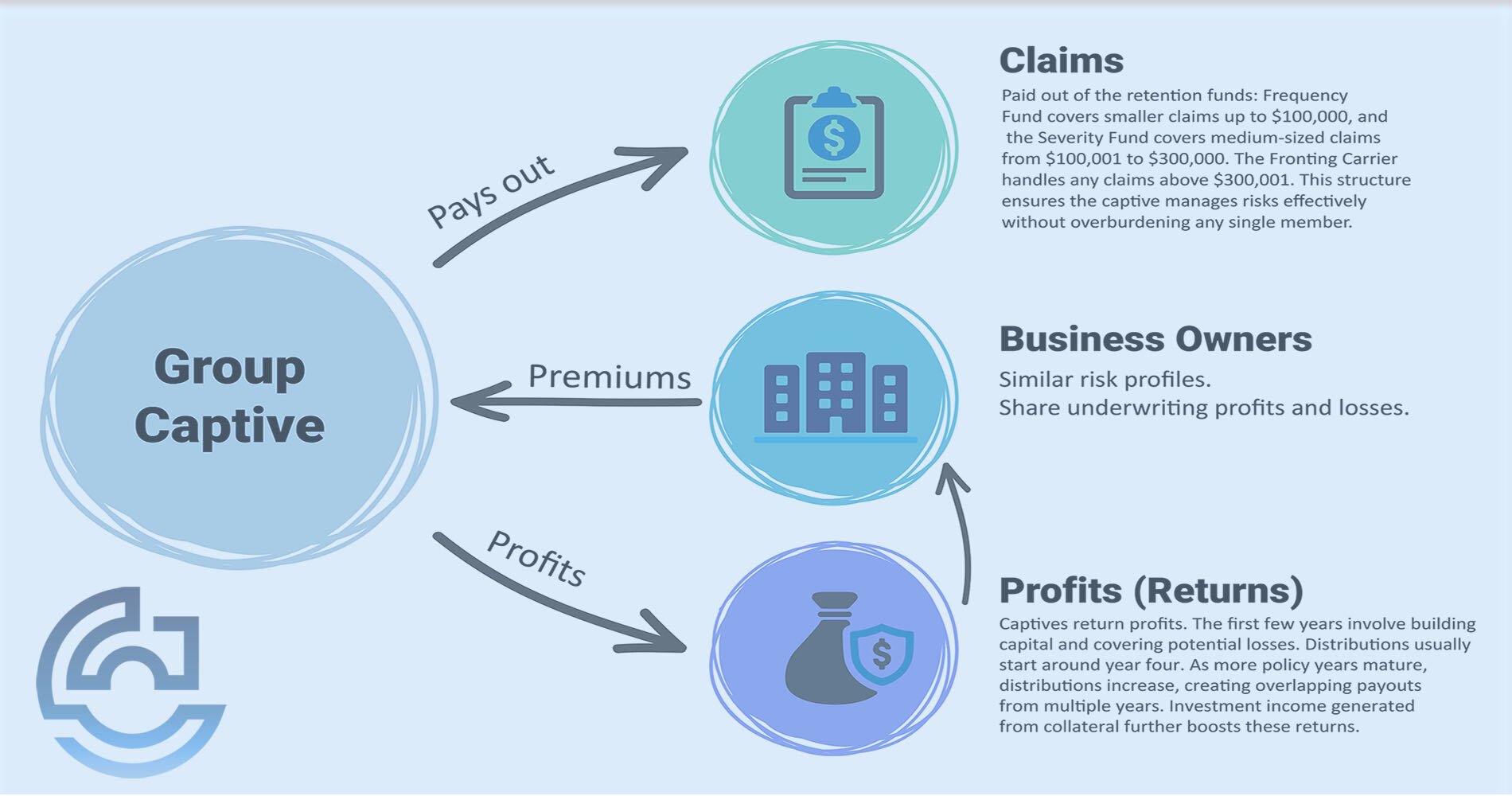
- Frequency fund: 70% of that year's loss fund, for everyday claims.
- Severity fund: The other 30%, for larger claims.
The captive sets the 70/30 split. Once established, the same allocation applies to every member.
Claim size determines which fund it goes against. A single claim up to $100,000 is a frequency claim. If it's over $100,000, the entire claim counts as severity.
This is why several smaller claims can drain the frequency fund, even when none of them is particularly large.
Your client's loss fund is only the first layer. Above it, members share another layer, with reinsurance sitting on top. (Can One Bad Year Wipe Out a Captive?)
When Can a Group Captive Member Receive an Assessment?
When claims for a policy year run past the frequency fund.
Everyday claims are the root cause of an assessment. A large claim can still play a part. When a policy year is settled, your client's largest claim gets counted first. If that claim uses up their own funds, there may not be enough left in the frequency fund to cover the smaller claims. Those claims can push the account into an assessment.
Assessments also have nothing to do with premium audits. Your client could owe an audit adjustment and an assessment for the same policy year. They're two separate things.
There are two important limits to understand:
- It's capped. The most your client can pay for a given policy year is that year's premium plus one frequency fund. Collateral, share price and audit adjustments are separate and don't count toward the cap.
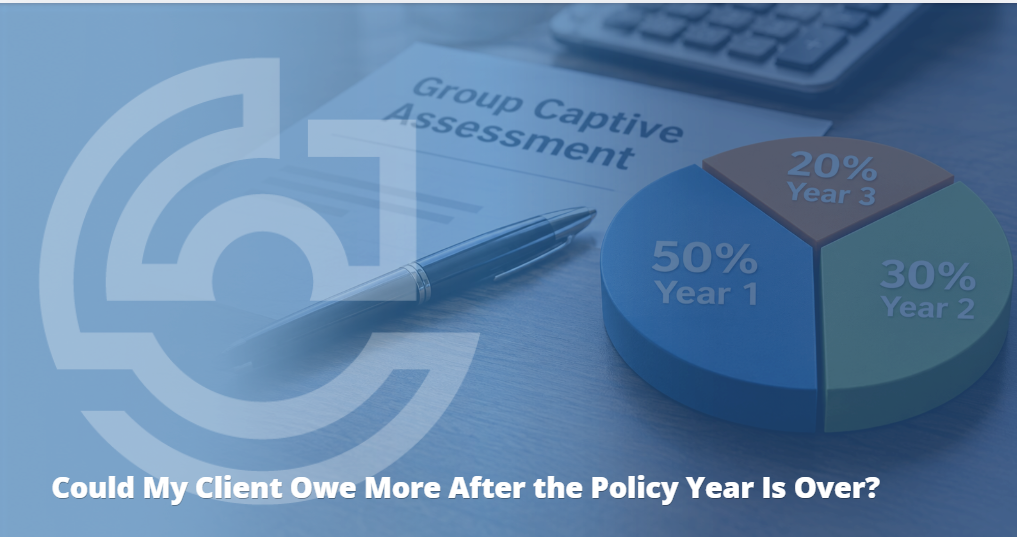
- It's spread out. The assessment is billed over three years: 50% in the first year, 30% in the next and 20% the year after. Billing starts at your client's next policy-year start.
The assessment is based on incurred losses. That means what's already been paid, plus what's reserved for open claims. Since claims can take time to settle, the amount isn't necessarily final right away. If a claim settles for less than originally reserved, the amount can go down. If reserves increase, it can go up, but never beyond the cap.
How Much Could a Group Captive Assessment Cost?
Let's put some numbers to it. These are examples for illustration. The size of the loss fund depends on the captive and its expense load. Your client's actual numbers will depend on their own program and loss history.
Here's a business with a $500,000 annual premium:
- Premium: $500,000
- Loss fund, after fixed costs: $310,000
- Frequency fund (70%): $217,000
Now say a rough year brings $350,000 in everyday claims and no large claims. That's $133,000 over the frequency fund. Since the shortfall is below the $217,000 cap, the assessment would be $133,000.
How the $133,000 assessment is billed:
|
Payment period |
Amount |
|
Next policy year (50%) |
$66,500 |
|
Year after (30%) |
$39,900 |
|
Year after that (20%) |
$26,600 |
|
Total |
$133,000 |
Now say it was a really bad year, with $500,000 in everyday claims. The shortfall would be $283,000. But the assessment can't exceed the $217,000 frequency fund cap.
So the most this client could pay for that policy year is $717,000: the $500,000 premium plus a $217,000 frequency fund.
That's a number your client should understand before joining. It's much better to have that conversation at the beginning than after a bad claims year.
Can a Bad Policy Year Affect Other Years?
No. Each policy year settles on its own.
Business owners often ask about this. Let's say year one results in a $133,000 assessment. Year two comes in well under its loss fund. The surplus from year two doesn't reduce the year one bill.
Your client could pay an assessment for one year and receive money back from another. The results don't simply cancel each other out.
What Are the Financial Risks of Captive Assessments?
In a captive, your client's own losses drive their costs, in both directions.
A good year can mean money back, but not right away and not guaranteed. Payouts are staggered over several years, starting in year four, because open claims can still develop. The amount returned also depends on risk sharing with other members, not just your client's own claims.
A bad year can mean paying more, up to the assessment cap.
Traditional insurance has its own trade-offs. Deductibles, premium audits and renewal increases after a poor claims year are common. The difference is how much of the risk your client carries. In a captive, they're more directly affected by their own results, both good and bad.
That's the trade.
If your client can't manage a full frequency assessment spread over three years without straining cash flow, a captive may not be the right fit.
What If Your Client Leaves the Captive?
Leaving doesn't mean walking away from outstanding assessments. Any open assessments are still owed.
Collateral is also held until every policy year closes, typically five to seven years. Your client needs to understand this commitment before joining. It shouldn't come as a surprise if they decide to leave.
How Do You Size Up Your Client's Assessment Exposure?
There are three things to make sure your client understands:
- An assessment is possible after a bad claims year.
- The cap sets the maximum amount, and the billing schedule determines when it's paid.
- The business needs to be able to handle a bad year financially.
Start by sending Captive Coalition your client's loss runs. Along with their exposures and program details, we can review their frequency fund, assessment cap and what a bad year might mean for the business.
The idea isn't to put every client into a captive. It's to find the ones who are a good fit and understand what they're taking on.
Related Resources
- Can One Bad Year Wipe Out a Captive? Read this next to see how the shared layer and reinsurance protect your client above their own funds.
- What's the Worst Case Scenario in a Captive? Useful when an owner wants to understand the full downside.
- Will Captive Insurance Help My Client With Cash Flow? For clients weighing whether they can manage the financial commitment of a bad year.
It's always your client. Never ours.
Options for clients where cash flow is the sticking point.