
How to Evaluate Group Captive Structures in 2026
August 4th, 2026
7 min read
The 30 second version
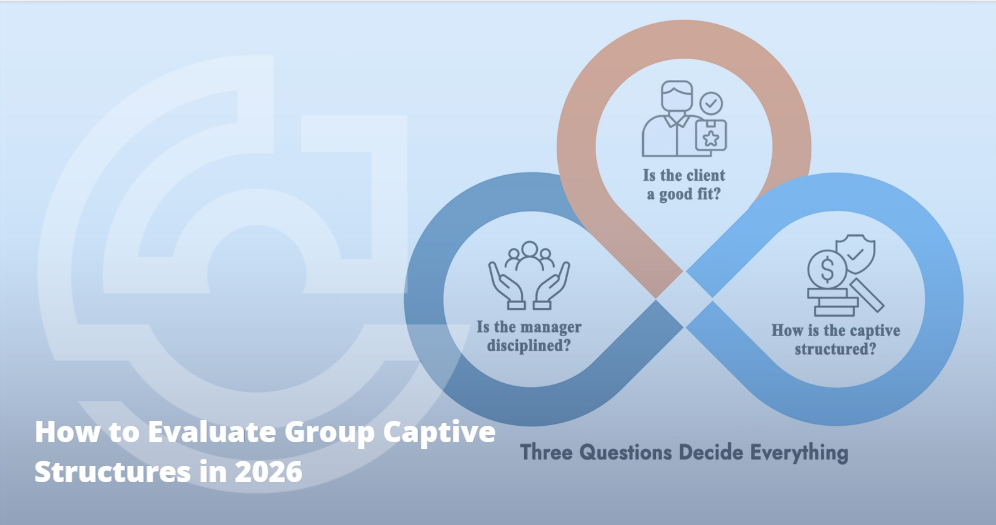
Three judgments decide everything: whether the client is a good fit, whether the manager is disciplined, and how the program is structured.
Baseline client profile: $250,000 or more in annual casualty premium, a stable or improving loss trend, and safety owned by leadership.
A captive is a 5- to 7-year business decision, not a way to cut next year's premium.
Chapter 01
Why This Matters Right Now
Independent agents are fielding more captive questions than ever, and for good reason. As commercial insurance costs continue to rise, well-run companies are looking for alternatives that reward strong safety performance rather than forcing them to subsidize someone else's bad risk.
But not every captive is created equal. The challenge is not understanding how a captive works. It is determining whether a specific client is a good fit, whether the captive manager is running a disciplined program, and whether the structure is designed to protect members over the long term.
A group captive can be a powerful alternative for the right business. Recommending the wrong program creates frustration for both the agent and the client.
It comes down to three questions
1
Is the client a good fit?
Well-managed, mid-sized, at least $250,000 in annual casualty premium, and a loss trend that is stable or getting better.
2
Is the manager disciplined?
Selective about who gets in, transparent with financials, focused on protecting existing members. Growth never at the cost of underwriting discipline.
3
How is it structured?
A good program does not just move risk from a carrier to a group. It defines layers: individual retention, shared pool, reinsurance.
Chapter 02
What a Group Captive Is, and Why it Matters
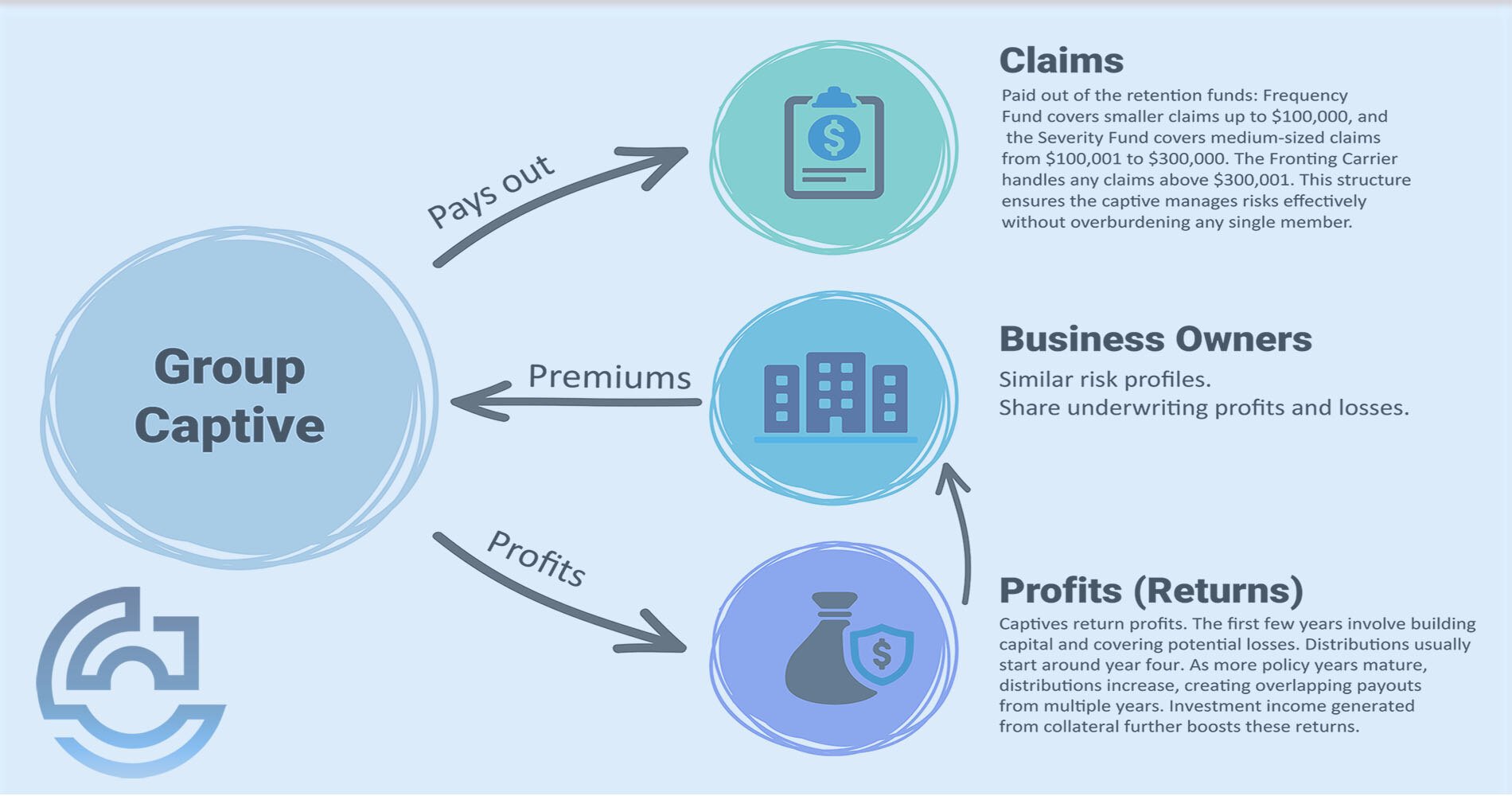
A group captive is an insurance company owned by its members. Those members are businesses with similar risk characteristics that come together to share insurance risk and benefit from strong underwriting results.
Instead of paying premiums into a traditional program where underwriting profit stays with the carrier, captive members have the opportunity to benefit when the group performs well.
Businesses that control their losses should not have to subsidize businesses that do not.
For casualty lines like Workers' Compensation and General Liability, better performance translates directly into better financial results.
| TRADITIONAL GROUP | Group captive | |
|---|---|---|
| Underwriting profit | Kept by the carrier | Potentially returned to members |
| Pricing | Market and class averages | Based largely on member performance |
| Transparency | Limited | Full visibility into claims and reserves |
| Risk ceiling | Determined by the carrier | Defined through retention and reinsurance |
| Horizon | Annual renewals | Typically 5 to 7 years |
Chapter 03 / Step one
Does Your Client Actually Qualify?
Not every business belongs in a group captive. The best candidates share three things: financial stability, a real commitment to safety, and leadership that understands insurance performance is tied to business operations.
Annual casualty premium
Most group captives look for at least $250,000 in annual casualty premium across Workers' Compensation, General Liability, and Commercial Auto. Exceptions exist, but below that line the fixed costs of participating often outweigh the benefit.
Loss history
A perfect loss record is not required. What matters is a stable or improving trend over the past three to five years. Captive managers look beyond the claim totals to see whether management identifies problems, corrects them, and continues to improve.
Safety culture
Captives reward companies where safety is a management priority rather than a compliance checkbox. Signs of the real thing:
- Executives personally involved in safety initiatives
- An active return-to-work program
- Near miss reporting that people actually use
- Continuous employee training
- Leadership that knows and watches its Experience Modification Rate
Is this client a fit for a captive?
Six questions pulled from what captive managers actually underwrite on. Answer for one real client. Nothing is saved unless you ask us to look at it.
Question 1
Score
Where they landed
What to do next
This is a directional screen, not an underwriting decision. Final eligibility depends on full submission data including five years of policies, audits, and loss runs.
Chapter 04 / Step two
Evaluating the Captive Manager
The captive manager has more influence on long-term success than almost anything else. A manager with real underwriting discipline evaluates applicants carefully, monitors member performance, and makes decisions that protect the group as a whole.
Ask these before you recommend anything
- How selective is the underwriting process?
- What percentage of applicants get declined?
- What happens when a member's performance deteriorates?
- How often are underwriting results reviewed?
- What financial reporting do members receive?
The biggest difference between strong and weak captives lies in how they approach growth. The goal is not the largest possible membership. The goal is a group of businesses that share similar risk characteristics and a commitment to improving performance.
Chapter 05 / Step three
How a Captive Actually Shares Risk
Most agents and business owners assume joining a captive means taking on unlimited risk. This is the single most common misconception, and it is wrong. A properly structured captive creates clear financial boundaries through layers.
Individual retention
Each member is responsible for losses up to a set amount, often between $250,000 and $500,000 per occurrence. This creates a direct financial incentive to prevent claims.
Shared risk pool
Losses above individual retention are allocated to a pool funded collectively by the members. Because everyone shares this layer, careful member selection becomes critical.
Reinsurance protection
Above the pooled layer, excess reinsurance caps catastrophic exposure. Members are not facing unlimited claims. They are participating inside clearly defined financial boundaries.
Where does a claim actually land?
The most common misconception about captives is that members take on unlimited risk. Drag a claim through the structure and watch what really happens.
Your client's own money. This is the layer that creates the incentive to prevent claims.
Funded collectively by the members. This is exactly why member selection has to be disciplined.
Catastrophic protection sitting above the pool. This is the ceiling on the whole structure.
Illustrative structure only. Actual retention, pool attachment, and reinsurance layers vary by program and by member. Ask any captive manager these three numbers before you recommend their program.
General Liability considerations
General Liability responds well to operational discipline, but it is long-tail, meaning claims can surface years later. Reserve management matters more here than anywhere. Ask how case reserves are set, reviewed, and actuarially overseen.
Workers' Compensation performance
Workers' Comp is where operational discipline produces the biggest financial impact. An Experience Modification Rate below 1.00 is encouraging, but also look at claim frequency, claim severity, return-to-work practices, safety training, and how involved management actually is. A single good year is not enough. Captives reward consistency.
Chapter 06
What it Actually Costs to Join
Joining a group captive takes more than paying a premium. Before you recommend one, make sure your client understands all three commitments.
Initial capital contribution
Members typically buy a share in the captive, often $25,000 to $50,000, which is returned on exit subject to outstanding loss obligations.
Collateral
Most programs require collateral in the form of cash or a Letter of Credit. It secures future claim obligations and protects the captive. The amount is usually based on expected losses and may equal one to two times the member's expected annual losses. Depending on structure, it may earn investment income, and it is generally released as claims close.
Ongoing premium
Members continue to pay premiums to fund expected losses, reinsurance, administrative, and operating costs. For members who perform, total long-term cost often compares favorably with the traditional market while providing far more transparency.
Chapter 07
When Clients Should Expect Results
This is the conversation most agents skip and later regret. A group captive is not built to produce first-year savings. It is a long-term strategy built on improving claims performance and letting members benefit from favorable underwriting results.
Years 1 to 3
Building the foundation
Reserves build and claims history establishes. Savings are modest, as expected.
Years 4 to 7
Results start showing
Potential dividend distributions and underwriting profit as claims close and reserves prove adequate.
Beyond year 7
Compounding
Greater equity accumulation and increasingly predictable insurance costs.
The point to land with the client: a captive is a business decision, not a way to reduce next year's premium.
Chapter 08
Red Flags That Should Make You Walk Away
Not every captive deserves your client's business. Proceed carefully if you see any of these.
Minimal underwriting standards
If a program accepts everyone, you are looking at adverse selection. Your good client will end up funding somebody else's losses.
Opaque financial reporting
Reluctance to share claims detail, reserves, or results is a warning. Transparency is the whole point of member ownership.
Guaranteed savings
Be skeptical of anyone promising a number. Responsible managers talk in ranges and scenarios, not guarantees.
A manager who wants your client
If the program treats you as a referral source instead of a long-term partner, you already know how that ends.
Chapter 09
Your Pre-recommendation Checklist
About your client
- Do they meet the premium threshold?
- Is their loss history improving?
- Is safety part of the company culture?
- Can they commit to a long-term strategy?
- Are they prepared for capital and collateral requirements?
- Are they ready for a 5- to 7-year investment?
About the captive manager
- How selective is underwriting?
- How are poor-performing members handled?
- How is an adverse year handled?
- What reporting is provided?
- How is transparency maintained?
- How are independent agents supported?
About the program structure
- What are the retention limits?
- How is pooled risk managed?
- Where does reinsurance attach?
- How is collateral calculated?
- When should members expect distributions?
Frequently asked questions
What is the minimum premium required for a group captive?
Most group captives look for at least $250,000 in annual casualty premiums across Workers' Compensation, General Liability, and Commercial Auto. Some programs consider exceptions depending on the business and its overall risk profile.
How long does it take to see financial returns?
Group captives are five- to seven-year strategies. Many members begin to see meaningful financial benefit after three to five years, as claims close and underwriting results develop.
What happens during a bad claims year?
A bad year does not mean unlimited exposure. Group captives manage risk through individual retention, shared risk pools, and excess reinsurance, which caps catastrophic exposure.
How does Captive Coalition protect the agent relationship?
We work exclusively with independent agents and never compete for clients. Your client stays your client.
Why is collateral required, and how much?
Collateral secures future claim obligations and protects the captive's financial stability. It typically runs one to two times expected annual losses via cash or a Letter of Credit, may earn investment income, and is generally released as claims close.
Can coverage be customized?
Yes. Many programs offer flexibility in coverage terms, policy design, and risk management approaches to better align with members' needs.
Who is not a good fit for a captive?
Businesses with inconsistent loss histories, weak safety cultures, unresolved litigation, or leadership focused only on short-term premium savings are typically poor candidates.
The hard part is not the math. It is vetting programs without losing the client.
Run your best fit client through the questions above, then bring the conversation to us. We help you evaluate structures and stay at the center of the relationship.
Create AccountWarren Cleveland launched Captive Coalition after firsthand experience as an independent agency owner revealed a major gap in the market: agents lacked access to the knowledge and resources needed to compete with large brokerages offering captive insurance solutions. Warren brings over a decade of insurance leadership—including as President of ReNu Insurance Group—and a career that spans aviation, real estate, and commercial insurance. His mission is to ensure agents stay in control, keep their best clients, and confidently lead with captives. Warren Cleveland, ACI, CIC, AAI