

If you have a client spending serious money on casualty insurance and you've wondered whether a casualty group captive could make sense, you're not alone.
Most independent agents were never handed a simple framework for figuring that out.
A business doesn't have to be enormous. It doesn't automatically qualify because of its industry. And one bad claim doesn't necessarily rule it out.
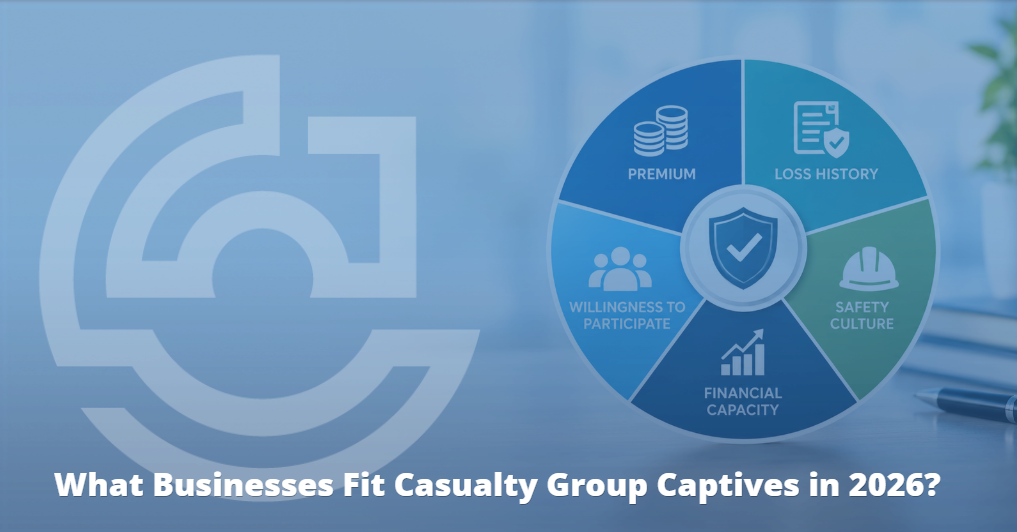
A better way to evaluate a potential candidate is to look at these five things:
- Premium
- Loss history
- Safety culture
- Financial capacity
- Willingness to participate
Premium gets a client evaluated; the other four help determine whether they belong.
How Much Premium Does a Business Need for a Casualty Group Captive?
A good starting point is $250,000 in combined annual premium across general liability, workers' compensation, and auto liability. The key word is combined.
For example:
- General liability: $60,000
- Workers' compensation: $120,000
- Auto liability: $90,000
That's $270,000 in combined casualty premium.
The client has enough premium to warrant a closer look.
But premium alone doesn't qualify a business. It qualifies the client for the rest of the conversation.
Look at Casualty Premium, Not Just Company Size
Agents sometimes assume captive-sized clients have to be much larger than the accounts they normally write.
That's not necessarily the case.
A $15 million manufacturer paying $300,000 in casualty premium may be worth evaluating. A $100 million company paying $80,000 may not meet the same starting point.
Revenue and employee count tell you something about a business. But when you're evaluating a casualty group captive, start by looking at how much risk the client is actually transferring through insurance.
And there may already be captive-sized accounts sitting in your book.
Pull your commercial accounts, add the general liability, workers' compensation, and auto premiums, and see who clears the $250,000 mark.
That's a screening exercise, not a major project.
You can also run the numbers through the Captive Coalition captive insurance calculator to get a better idea of what the structure could look like.
How Does Loss History Affect Captive Eligibility?
Loss history matters more than the industry name.
Manufacturing, construction, trucking, hospitality, and distribution can all have businesses that fit a group captive.
The better question is what the client's last three to five years of loss runs look like.
Look for Patterns, Not Perfection
The target isn't a spotless loss history.
Compare the client against their industry benchmarks, not against zero.
One unusual severe claim doesn't necessarily tell you how the business manages risk. A company can have a bad accident and still have a strong overall operation.
Recurring frequency is a different story.
A steady stream of smaller claims year after year may tell you more about how the business operates than one large loss.
The direction of the losses matters, too.
A contractor that had a rough year three years ago but has steadily improved since then may look very different from a business with mediocre results that haven't changed.
What About Open or Undeveloped Claims?
A large open or undeveloped claim doesn't always mean "no."
It may simply be a timing issue.
If a significant claim is still developing, an underwriter may not have enough information to accurately evaluate the client's risk. In that case, the conversation may make more sense later.
Repeated severe losses with no evidence that anything changed afterward are different.
That's a risk management problem, not an insurance-structure problem.
No captive can fix an unmanaged risk.
Does Industry Determine Whether a Business Can Join a Captive?
Not by itself.
Industry comes into play at the edges. Some classes are difficult or impossible to place because the potential severity is too high, the exposure is difficult to pool, or regulatory requirements make the structure impractical.
But an agent shouldn't automatically rule out a client because of an industry label.
If the account is borderline, prequalification is a better answer than a guess.
This guide looks at the lines of business that may fit a captive.
Why Does Safety Culture Matter in a Group Captive?
A client who treats safety as a compliance exercise may not be ready for a captive, regardless of what the loss runs say.
The reason is simple: a captive works best when the client understands that its own actions can influence its loss results.
Three questions can tell you a lot.
Who Owns Safety Inside the Company?
Ask who is responsible for safety and what happens when a problem is identified.
An owner who can name the person responsible and explain the process is giving you useful information.
An owner who simply says, "We have a safety manual," is giving you a different answer.
What Changed After the Last Significant Claim?
This may be the most revealing question you can ask.
If a serious claim led to new training, procedures, equipment, supervision, or other changes, that's important.
If nothing changed, ask why.
What Is the Business Doing to Reduce Claims?
You aren't looking for a perfect answer.
You're looking for evidence that the business is paying attention.
If the experience modification rate is climbing and recordable claims are trending up, the captive conversation may not be the one to have yet.
The risk management conversation is.
And risk management audits can create value and revenue for independent agents.
Don't Lead With the Potential Savings
This is an important distinction.
If the first thing a client hears is that they may receive underwriting profit or reduce their insurance costs, they may hear only one thing:
"This could be cheaper."
That's not the conversation you want.
A captive is a long-term risk strategy. The client's safety and claims performance directly affect the results.
What Financial Capacity Does a Captive Candidate Need?
Joining a captive involves commitments beyond the annual premium.
Depending on the structure, the client will have collateral requirements and an equity contribution. That money needs to be committed for a period of time.
The client doesn't have to be a huge company.
What matters is whether the business has enough financial stability to make the commitment without creating financial strain.
What Financial Warning Signs Should Agents Watch For?
You don't need to be a financial analyst to recognize some ordinary business warning signs:
- Working capital is chronically tight.
- A major financing need or acquisition is on the horizon.
- Revenue swings significantly from year to year.
- The owner is uncomfortable committing capital for several years.
If funding the collateral would hurt the business, the timing is wrong.
That's not a failed prospect. It may simply mean the client needs another year to strengthen the business before revisiting the opportunity.
Current Captive Coalition captive terms are outlined here.
Is the Business Owner Willing to Participate in a Captive?
This is where a qualified prospect and a good long-term member can be two different things.
A captive is different from simply buying a traditional insurance policy.
Depending on the structure, members may participate in governance, board meetings, risk management activities, and claims oversight.
Some owners hear that and lean in.
Others hear extra work.
Both reactions are useful to know before the client joins.
A Captive Is Not a Fix for One Bad Renewal
If the only reason a client is interested is because their renewal went up this year, slow down.
A captive is a multi-year strategy.
A client looking for immediate relief may become frustrated with the commitment and longer-term nature of the program.
Try asking:
Are you interested because your renewal came in high, or because you want a different long-term relationship with your insurance costs?
The answer can tell you a lot.
This article takes a closer look at evaluating group captive structures over the long term.
How Can Agents Tell if a Client Is Ready for a Captive?
Once you've looked at premium, loss history, safety culture, financial capacity, and willingness to participate, the picture becomes much clearer.
|
What you're seeing |
What it means |
|
$250K+ combined premium, stable or improving losses, and an owner who takes safety seriously |
Worth evaluating |
|
$250K+ premium, but safety is treated as a compliance exercise |
Risk management conversation first |
|
$250K+ premium, but collateral would strain the business |
Not ready; revisit later |
|
Strong operation, but a large claim is still open and undeveloped |
May be a timing issue |
|
Under $250K in combined premium |
Generally below the starting benchmark |
|
Owner is looking only for a cheaper renewal |
Expectations may not match a long-term captive strategy |
|
Repeated severe losses with no meaningful changes afterward |
Address the risk first |
|
Owner doesn't want governance, meetings, or claims involvement |
May not be the right fit |
A client landing in one of the "not ready" categories isn't a failed prospect.
It's a useful answer.
Knowing when a captive isn’t the right fit is just as important as knowing when it is.
What Do Agents Need Before Bringing a Client to a Group Captive?
In many agencies, qualified clients sit in the book and never get the conversation.
Not because they don't fit.
Sometimes the agent doesn't have a process for evaluating them or doesn't feel comfortable presenting something they can't take all the way through.
A captive submission can involve several years of loss runs, policies, audits, experience modification information, safety details, and financial information.
Smaller agencies don't always have someone dedicated to pulling it all together.
So the conversation never happens.
How Can Independent Agents Get Started?
You don't need to become an actuary or captive expert before bringing the idea to a client.
Captive Coalition's prequalification process, underwriting support, and client-facing materials are designed to help independent agents evaluate potential clients and prepare them for the next step.
The client onboarding timeline is also outlined here.
Keep the Client Relationship With the Agent
There's another question agents should ask before introducing a client to any captive manager:
Who owns the client relationship after the client joins?
Captive Coalition's approach is simple:
The client is always the agent's client.
We don't accept broker-of-record transfers on accounts an agent brings into the program.
That's worth asking about before making any captive introduction.
When Should an Agent Start the Captive Conversation?
Don't wait until renewal.
A client under renewal pressure wants a number. A captive is more complicated than a number, and it takes time to evaluate.
One of the best times to start the conversation is the month after a renewal closes.
There's nothing to decide immediately, and you have an entire year to explore the idea.
Keep the First Conversation Simple
You don't need a 30-slide presentation.
Start with curiosity.
You might say:
"I've been looking at an approach that may be worth a conversation based on your premium and loss history. I'm not saying it's right for you. I want to take a look at it together."
That's enough.
You're not promising savings.
You're not telling the client they should join.
You're simply bringing them an option worth exploring.
Which Clients in Your Book Should You Evaluate for a Captive?
If you've always assumed captive clients had to be very large businesses or belong to a particular industry, it's worth looking at your book a little differently.
Start with the premium.
Then look at:
- Loss history
- Safety culture
- Financial capacity
- Willingness to participate
Premium gets a client evaluated; the other four factors help determine whether the client belongs in the conversation.
Start with the two or three accounts that came to mind while reading this article.
Add their general liability, workers' compensation, and auto liability premiums.
Look at the loss history and safety culture.
Then run the numbers through the captive insurance calculator.
If the client looks like a potential fit, that's where the next conversation begins.
It's always your client. Never ours.

Topics:
