
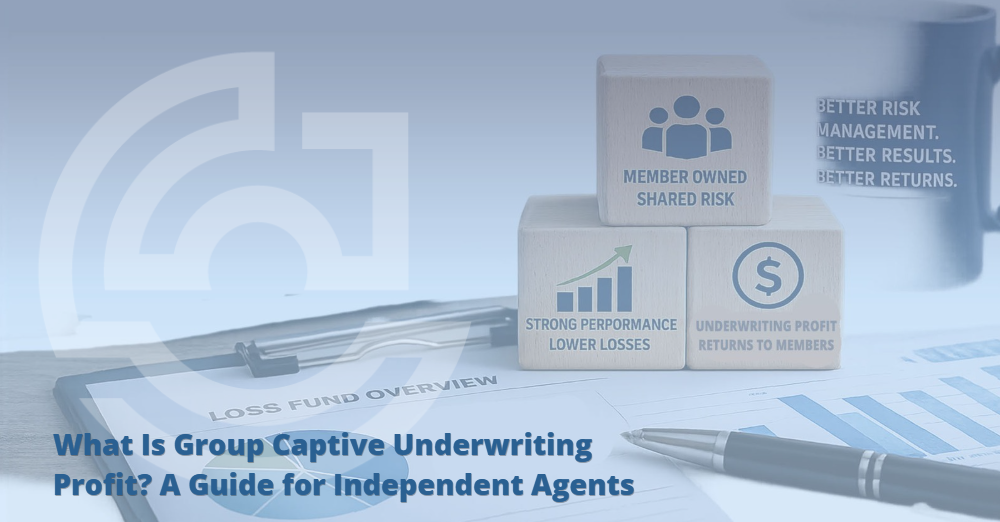
Group captive underwriting profit is the amount remaining after a captive collects premiums, pays claims, and covers operating expenses. In traditional insurance, that surplus goes to the carrier; in a member-owned group captive, it may be returned to members.
For illustrative purposes, group captives are often structured so that roughly 65 cents of every premium dollar funds expected losses and 35 cents covers operating expenses. Any remaining balance in the loss fund after claims are settled represents underwriting profit, which may be distributed back to members once the underwriting year closes (typically 3–5 years later).
Why Your Best Clients Care About “Where the Money Goes”
Your client asks about joining a group captive, and it comes down to one question: "What happens to the money if we don't have claims?"
In the traditional market, the money disappears into the carrier's pocket, no matter how clean the loss record.
In a group captive, that surplus can come back to the member. By the end, you'll understand what underwriting profit is, how it's calculated, where it goes, and what determines whether your client earns a return.
How Underwriting Profit Is Generated in a Group Captive
Underwriting profit is what remains after the captive collects premiums, pays claims, and covers admin costs. For every premium dollar, ~65 cents goes into a loss fund for future claims, and ~35 cents covers operations. Whatever sits in that loss fund after claims settle becomes underwriting profit. Traditional insurance keeps it; a member-owned captive returns it.
|
Traditional Insurance vs. Group Captive: Where the Profit Goes |
||
|
|
Traditional Insurance |
Group Captive Insurance |
|
Who keeps the underwriting profit? |
The carrier |
The member businesses |
| Visibility into the money | None | Full transparency on the loss fund |
| Reward for low claims | Carrier benefits | Member benefits |
| Investment income on reserves | Retained by the carrier | Allocated to member returns depending on program structure |
| Timeline | None | Distributed as the underwriting year closes |
How Does It Get Generated?
Members pay premiums based on actuarial analysis of their loss history, with losses divided into two buckets: the A Fund handles frequency losses ($0–$100,000), and the B Fund covers severity losses ($100,001–$500,000). Predictable claims get funded while larger losses are shared. When claims come in below projections, unused funds remain — that's underwriting profit.
Where Does It Go?
In a member-owned captive, the owners are the businesses, so the profits stay with them. Two paths: distributed back as dividends once the underwriting year closes, or retained in surplus to strengthen reserves. Most captives wait 3–5 years to close a year (long-tail liability claims). Once closed, members receive their share of unused loss funds plus investment income.
What Drives Underwriting Profitability in a Captive Program?
- Claims frequency and severity — fewer, lower-cost claims keep more in the loss fund.
- Operational efficiency — lean captives leave more for distributions.
- Premium accuracy — underpricing relative to risk shrinks profit.
- Investment income — reserves invested in low-risk assets add to the total return.
How Different Lines of Business Affect Distribution Timing
Property claims often resolve quickly, allowing profits to be distributed within 6–12 months after the policy year. Liability (workers' comp, GL) develops over the years, so profits may not be distributed until year four or later on a staggered schedule. It's long-term benefit tied to sustained risk management, not instant gratification.
Why Underwriting Profit Matters for Independent Agents
Clearly explaining underwriting profit turns insurance spend into a financial asset in your client's eyes. Clients with strong loss records stuck in the traditional market are leaving money on the table for carrier shareholders. Agents who understand captive economics retain their best clients — competing on value, not price.
How Clients Can Improve Their Captive Performance
Successful members invest in risk management before problems happen, take safety seriously, and engage with claims oversight. Advise regular risk audits, a culture of early hazard reporting, and remember that every prevented loss is retained profit. Captive participation rewards discipline.
The Broader Financial Impact of Group Captives
- Loss reduction — members are incentivized to implement stronger safety programs.
- Loss prevention — preventing losses entirely means larger shared profits.
- Net present value of reserves — funds earn interest while in reserve, reducing the ultimate net cost of claims.
Group Captives vs. Traditional Insurance: The Key Difference
Traditional insurance: carriers assume all the risk and keep all the underwriting profit. Your client pays premiums, files claims when needed, and has zero visibility into what happens with their money.
Group captives: Members share risk within defined layers, maintain transparency over their insurance costs, and retain underwriting profit when performance is strong.
What the Data Shows About Group Captive Performance
Data from established group captive programs, as reported by the Insurance Information Institute, show that members received dividend distributions in 98% of closed accident years, with more than 70% of those years returning dividends exceeding 15% of members’ contributions to loss funds.—
These results reflect documented outcomes from mature programs with strong safety and risk management performance, rather than projections. For broader context on group captive structures and governance, see the Captive Insurance Companies Association CICA, educational resources from IRMI, and regulatory guidance from the National Association of Insurance Commissioners NAIC.
Final Takeaway for Agents
Group captive underwriting profit is the money left after premiums pay claims and expenses — and in a member-owned captive, it belongs to your client, not a distant carrier. Understanding this lets you show clients where their dollars go, how performance drives returns, and why captives reward the discipline they already practice. The Captive Coalition Learning Center has agent-focused resources, and our team can help you bring the conversation to clients while you stay at the center of the relationship.

It's always your client. Never ours.
FAQs
What is underwriting profit in simple terms?
The money remaining after premiums pays claims plus expenses; in captives, it flows back to members, not carrier shareholders.
How long to receive distributions?
Most captives close a year after 3–5 years; members then receive unused loss funds plus investment income.
Can a member lose money?
A bad claims year can reduce or eliminate profit, but member screening and risk-sharing structures protect against catastrophic individual exposure.
Which businesses benefit most?
A business with strong safety programs, low claims frequency and proactive risk management.
How does underwriting profit differ from investment income?
Underwriting profit comes from premiums exceeding claims and expenses, and investment income comes from investing reserves. Members benefit from both.