

If you're reading this, a client has probably already asked you the question. Or you can feel it coming.
They're looking at a captive. They like the idea of being rewarded for running a well-managed business. Then they ask what really matters to them:
When does the money come back, and how much is it?
That's a fair question.
It's also when a lot of good agents go quiet. Not because they don't understand captives. It's because the honest answer has more moving parts than a renewal quote, and nobody wants to guess in front of a client they've had for 12 years.
We build and manage these programs, and this is one of the most common questions agents ask.
So let's take it apart. Not so you can quote a percentage. So you can explain how the money works and help your client understand what actually drives the result.
Where Does Group Captive Premium Actually Go?
In the traditional market, your client pays a premium to an insurance carrier. The carrier pays claims and operating expenses, and any underwriting profit belongs to the carrier.
Your client may have a clean year, invest heavily in safety, and keep claims low. They may still see their renewal premium increase because of market conditions, class pricing, or other factors.
In a group captive, the members own the insurance company.
Premiums fund expected losses and program operating costs. Those costs can include the fronting carrier, claims administration, actuarial services, reinsurance, and other program expenses.
The remaining funds support the captive's loss reserves.
If actual losses are lower than expected and the captive has adequate reserves, the resulting underwriting profit can become available for distribution to members, depending on the program's structure and governance.
That's the fundamental difference: favorable underwriting results can benefit the member-owners instead of automatically becoming the carrier's underwriting profit.
But surplus doesn't simply move back to members at the end of every policy year.
The captive needs enough money to pay claims that are still developing. The board and the captive's governance process determine when funds can be released safely.
Your client is one of the owners participating in that process.
That's an important part of the model, and they should understand it before they join.
If your client wants to see how the money moves through an A/B captive, this overview of transparent group captive insurance is a useful resource.
How the A/B Structure Affects What Comes Back
In an A/B captive, loss funding is divided into two primary funds.
The A Fund handles more frequent, smaller claims.
The B Fund covers larger, less frequent claims.
The exact dollar thresholds and funding levels depend on the captive's structure. In Captive Coalition's A/B model, the A and B Funds work within a larger structure that also includes group risk sharing and the fronting carrier above the captive's retention.
That matters because clients often hear "A/B captive" and immediately think of the worst-case scenario.
One terrible accident. One seven-figure claim. Their money is gone.
That's not how the structure is designed.
A/B captives are built with multiple layers of risk protection. The member has an individual loss funding component, the group shares risk within the captive, and excess protection sits above the captive's retention.
For example, Captive Coalition's ASCEND program has a $500,000 captive retention, with the fronting carrier above that level.
The bigger point for your client is this:
The goal isn't to avoid every large loss. It's to create a structure where businesses that manage their risks well can benefit from better underwriting results while still having protection against larger losses.
That brings us back to frequency.
A business that repeatedly has smaller, preventable claims can put more pressure on its loss funds than a business with an otherwise strong loss history that experiences an occasional unexpected loss.
That's why risk management matters so much in a captive.
The tradeoff is capital.
Retaining more risk means posting collateral, and collateral is real money tied up instead of being used elsewhere in the business.
That's part of the financial commitment that comes with participating in a captive.
If collateral is a concern, this article explains ways clients can lower their collateral requirements. You can also review the full A/B model breakdown.
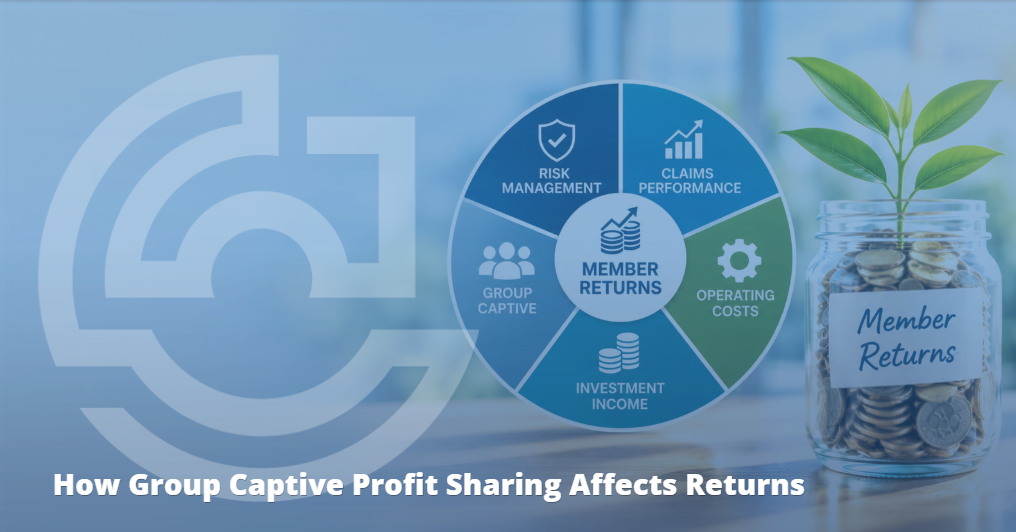
What Determines the Size of a Member's Distribution?
Several factors affect the result.
Your Client's Claims
This is the most obvious one.
When actual losses are lower than the amount funded for expected losses, more money may be available as underwriting profit.
When losses are higher, there may be less available for distribution. Depending on the structure, poor loss performance can also result in assessments.
The client's loss history and ongoing claims performance therefore matter a great deal.
Risk Management
Safety programs, loss control, early hazard reporting, return-to-work programs, and a culture that takes claims seriously can all influence loss performance.
This isn't just a soft benefit.
In a captive, better risk management can have a direct financial impact because the member has more exposure to its own loss experience.
That's also an opportunity for the independent agent.
Risk management audits are one way agents can provide additional value while helping clients improve their captive results.
How Efficiently the Captive Is Run
The captive's expenses matter.
Operating costs, claims administration, actuarial services, reinsurance, fronting costs, and other expenses all affect the amount available after losses and expenses are considered.
Ask the captive manager:
- Who is the fronting carrier?
- Who handles claims?
- Who provides actuarial services?
- What does reinsurance cost?
- How are the providers compensated?
Those aren't difficult questions. A good manager should be willing to answer them clearly.
Investment Income
Captive reserves may be invested while claims develop.
That investment income can become another component of the captive's overall financial results, depending on the program's structure.
But it shouldn't be treated as a guaranteed return.
There is no single formula that produces a guaranteed distribution percentage.
That's why responsible captive discussions should focus on the factors that drive the result rather than promising a specific return.
How the Risk Pool Affects Member Results
Think about your best client.
Five years of clean loss runs, but the insurance premium continues to climb.
They may reasonably ask:
"Why am I paying more when we aren't having the claims?"
One potential advantage of a group captive is that member results can be more closely tied to actual loss performance rather than the broader insurance market.
But this is where "group captive" stops being one thing.
The structure matters.
You need to understand how much risk the member retains, how much the group shares, where reinsurance attaches, and how the program handles poor-performing members.
Member selection matters, too.
A captive is only as strong as the discipline used to build and manage the group.
That means an agent shouldn't ask only how many members are in a captive. Ask:
- How does a member's own loss experience affect its financial results?
- How is risk shared among members?
- What happens when a member performs poorly?
- Who decides which businesses are admitted?
Those are returns questions, not just underwriting questions.
Before any of this matters, the client has to be a good fit.
For many group captives, a baseline starting point is at least $250,000 in annual casualty premium across Workers' Compensation, General Liability, and Auto. But premium alone doesn't determine eligibility. Loss history, financial strength, safety culture, and the client's willingness to make a long-term commitment all matter.
For ASCEND, Captive Coalition currently lists a $250,000 minimum premium.
When Do Group Captive Distributions Actually Arrive?
Distributions follow claims development, not the calendar.
This is one of the most important expectations to set with a client.
A policy year doesn't simply close when the policy expires.
Claims continue to develop. Some settle quickly. Others can remain open for years, especially Workers' Compensation and General Liability claims.
The captive needs to know enough about the ultimate cost of an underwriting year before it can determine how much money it can safely release.
Captive Coalition's current educational material notes that many captives wait three to five years to close an underwriting year, particularly because of long-tail liability claims.
That doesn't mean a client waits three to five years for any financial benefit. It means the financial results of a particular underwriting year develop over time. View the broader strategy as a long-term decision.
Captive Coalition describes a group captive as a five- to seven-year business decision, not a way to reduce next year's premium.
Tell your client this early. A client who understands the timeline from the beginning is much less likely to be disappointed later.
What Should You Tell Your Client About Captive Returns?
You're the one in the room. That doesn't change when your client joins a captive, and with us, it never will.
Your client doesn't need actuarial precision from you. They need a clear explanation of three things.
What affects the result?
Their claims and loss performance matter. So do the captive's expenses, investment income, reserves, reinsurance, and overall underwriting results.
What are they taking on?
They're participating in an insurance company they own with other members. That means taking on more responsibility than they would in a traditional guaranteed-cost arrangement.
They may have collateral requirements and, depending on the structure, exposure to assessments.
In return, they may be able to benefit from favorable underwriting results.
When might they see a distribution?
Not necessarily after the first year.
Claims need time to develop, and the captive must maintain adequate reserves before it can release funds.
That's not a sign that something is wrong. It's part of responsible captive management.
So, back to the question your client asked:
When does the money come back, and how much is it?
There is no single answer.
The amount depends on the client's loss experience, the captive's structure, expenses, investment income, and the financial decisions made as the underwriting year develops and closes.
The timing depends largely on claims development and the captive's distribution process.
That's why the best answer isn't a percentage.
It's a model.
Run the client's actual numbers before the meeting so they can evaluate the opportunity based on their own business, not a generic example.
Run them through the captive insurance calculator.
You bring the relationship. We give you the tools to protect it.
It's always your client. Never ours.