
If you've ever watched a client get hit with a double-digit renewal increase — after years of clean loss history — you already know the frustration built into guaranteed cost insurance. Premiums swing with the market, not with performance. And your best clients end up subsidizing the industry's worst performers.
This guide compares group captive insurance versus guaranteed cost insurance across every dimension that matters to your clients: how premiums are set, who qualifies, what the financial mechanics look like, and when each model is actually the right fit. By the end, you'll have a clear framework for identifying which clients are ready for a captive conversation — and which ones aren't.
Captive Coalition helps independent agents navigate exactly this decision without risking their client relationships or book of business.
Key Takeaways: Group Captive Insurance vs Guaranteed Cost
- Group captives base premiums on your client's actual five-year loss history; guaranteed cost programs use industry averages and market rates.
- Captive members can reclaim unused loss funds as dividends after claims mature, typically three to four years into participation.
- Guaranteed cost insurance transfers all risk to the carrier but leaves your client exposed to market-driven premium swings each renewal.
- Captive Coalition trains independent agents to confidently present captive options while protecting their client relationships and book of business.
- Mature casualty accounts with strong safety programs and loss ratios below 50% are often ideal candidates for group captives.
What Is Guaranteed Cost Insurance?
Guaranteed cost insurance is the standard commercial insurance model most of your clients already know. The carrier sets a fixed premium at the start of the policy period, and your client pays that amount regardless of their actual claims during the term. If losses are low, the carrier keeps the difference. If losses are high, the carrier absorbs them.
This model offers simplicity and predictability within a single policy year. Claims handling, underwriting decisions, and policy terms all sit with the carrier — your client has limited input and limited visibility.
How Guaranteed Cost Premiums Are Calculated
Carriers calculate guaranteed cost premiums using a combination of industry loss data, state-mandated rates, and experience modification factors. Your client's individual loss history plays a role, but it's blended with broader market trends.
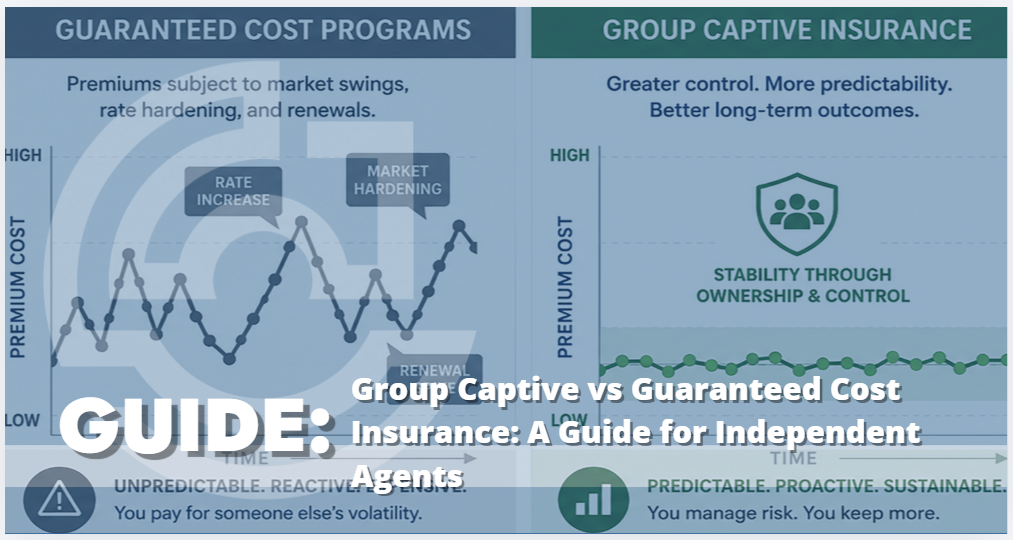
This means a company with excellent risk management still subsidizes riskier businesses in the carrier's portfolio. When the commercial market hardens — as it has for more than 25 consecutive quarters in some lines — premiums rise across the board, regardless of individual performance.
The Hidden Cost of Market Cycles in Guaranteed Cost Programs
The biggest downside of guaranteed cost insurance is exposure to market volatility. Commercial auto premiums, for example, have increased for more than 50 consecutive quarters according to industry data. Your clients with clean records pay the price for industry-wide loss trends.
When you present guaranteed cost as the only option, you're telling your client to accept whatever the market dictates at renewal. For accounts paying significant premiums year after year with few claims, this arrangement consistently leaves money on the table.
What Is a Group Captive Insurance Program?
A group captive is an insurance company jointly owned by the businesses it insures. Instead of transferring all risk to an outside carrier, member companies pool their premiums to fund expected losses while purchasing reinsurance for catastrophic events. Each member has a financial stake in how the captive performs.
Group captives are often homogeneous (members from the same industry) or heterogeneous (members from different industries with similar risk profiles). Most cover common casualty lines: workers' compensation, commercial general liability, and auto liability.
How Group Captive Premiums Are Determined
Unlike guaranteed cost insurance, group captive premiums are primarily based on each member's actual five-year loss history. If your client has maintained a loss ratio below 50%, their premium reflects that performance — not the industry average, which includes far less disciplined businesses.
Premiums are divided into two main pools: loss funds that pay claims, and operating costs that cover administration, claims management, and reinsurance. This structure means members see exactly where their premium dollars go — a level of transparency that guaranteed cost programs don't offer.
The Dividend Potential in Group Captives
Unlike guaranteed-cost programs, where unused premiums remain with the carrier, group captive members can reclaim unused loss funds as dividends. Once a policy year matures — typically after three to four years — funds not needed for claims flow back to members.
This creates a direct financial reward for good risk management. Your client's investment in safety programs, driver training, and loss prevention translates into tangible returns. One industry case study documented nearly $16 million in cumulative savings over 10 years by comparing captive costs with estimated traditional insurance expenses.
Group Captive Insurance vs Guaranteed Cost: Side-by-Side Comparison
Understanding the structural differences between these two models helps you position the right solution for each client.
| Factor | Guaranteed Cost | Group Captive |
|---|---|---|
| Premium Basis | Industry averages and market rates | Individual five-year loss history |
| Risk Transfer | Full transfer to the carrier | Shared among members; reinsurance covers large losses |
| Premium Stability | Subject to market cycles | Insulated from broader market swings |
| Unused Premiums | Retained by the carrier | Returned to members as dividends |
| Control Over Program | Limited—carrier makes decisions | Member voting rights on captive governance |
| Claims Involvement | Minimal involvement | Active participation in claims strategy |
| Transparency | No visibility into costs, other than premiums paid | Full transparency on premium allocation |
| Typical Commitment | Annual policy term | Five to seven-year horizon for full benefit |
Why Premium Volatility Matters to Your Clients
Premium volatility isn't just an inconvenience — it disrupts your client's ability to plan, budget, and grow. Understanding this pain point is central to positioning captive insurance vs. guaranteed cost as a strategic conversation rather than just a coverage comparison.
Budget Uncertainty Under Guaranteed Cost
When premiums can jump 10% or more at renewal with no warning, financial forecasting becomes guesswork. For businesses in the construction, manufacturing, or transportation industries with significant insurance spend, this uncertainty compounds. Every dollar diverted to unexpected premium increases is a dollar not invested in equipment, hiring, or expansion.
How Group Captives Reduce Premium Swings
Group captives insulate members from market volatility because premiums are set based on the captive's own loss experience rather than industry-wide trends. When the commercial market hardens, captive members don't automatically face the same rate increases that hit their guaranteed-cost competitors.
As a captive matures and accumulates surplus, it builds a buffer against rate fluctuations. This stability allows your clients to forecast insurance costs with greater confidence year over year.
Who Qualifies for a Group Captive Program?
Not every commercial account is the right fit for captive insurance. The model works best for companies that have already proven they manage risk well.
Loss Ratio Requirements
Most group captives require a loss ratio below 50%, evaluated across the past five years. Consistent, predictable losses signal a company that will perform well alongside other captive members. If an outlier claim inflates the ratio, the client may need to document the cause and what they've done to prevent recurrence.
Commitment to Safety and Risk Management
Group captive success depends on members actively managing their exposures. Companies that invest in fleet telematics, workplace safety training, and proactive loss control tend to thrive. If your client views risk management as a core business function — not just a compliance checkbox — they're likely a good fit.
Minimum Premium Thresholds
Group captives typically require a combined minimum premium starting around $250,000 across casualty lines. This threshold ensures that each member contributes enough to the pool to enable meaningful risk sharing and operational efficiency. Clients who don't meet this minimum today may become eligible as their business scales.
How to Identify Clients Ready for a Group Captive
Moving a client from guaranteed cost to a group captive is a significant decision. Captive Coalition equips independent agents with a clear framework for qualifying prospects without risking the relationship.
Three Indicators That Signal Captive Readiness
- Profitability to the carrier: If your client consistently pays more in premiums than they receive in claims over multiple years, they're effectively subsidizing others in the carrier's pool.
- Risk tolerance: Captive membership requires your client to accept some financial exposure for their own losses. They need to be comfortable betting on their own safety performance.
- Long-term mindset: Group captives reward patience. Dividends accumulate over time, and the full financial benefit typically materializes after five to seven years of participation.
- Volatile loss histories: If your client's loss ratio exceeds 50% or their claims are unpredictable, guaranteed cost may be the right fit until they improve their risk profile.
- Short-term flexibility needs: Businesses in transition — acquisitions, rapid growth, or uncertain futures — may not want to commit to a multi-year captive program.
- Insufficient premium volume: If your client doesn't meet the minimum premium threshold, guaranteed cost or other alternative programs may be the only practical option until their business scales.
Industries Well-Suited for Group Captive Insurance
Certain industries naturally align with the captive model due to high premium volumes and controllable risks. Construction, manufacturing, transportation, and distribution are common fits — sectors with significant workers' compensation and auto exposures where strong safety programs can meaningfully reduce losses.
Professional services firms with sufficient premium volume can also benefit, particularly if they have predictable liability exposures and disciplined risk management practices.
The Financial Mechanics of Group Captive Ownership
Understanding how money flows through a group captive helps you explain the value proposition clearly. This transparency is one of the captive's core advantages over guaranteed cost insurance.
Premium Allocation in a Typical Group Captive
When a member pays their annual premium, those funds are split across two main buckets. Roughly 65% goes into a loss fund that pays claims. The remaining 35% covers operating expenses — reinsurance, claims administration, actuarial services, and captive management fees. Some captives also fund small individual risk-control accounts that members can use for safety improvements, such as fleet training or workplace assessments.
How Dividends Are Calculated and Distributed
After a policy year closes and claims are settled, any remaining funds in a member's loss account are returned as dividends. This process typically takes three to four years, which is how long it takes for most claims to develop and close fully. The better your client's loss experience, the larger their potential dividend.
How Group Captive Governance Works
Group captives are member-owned entities. Each member company typically has a vote in captive governance — one member, one vote, regardless of premium size. Standing committees handle executive, finance, risk control, and underwriting decisions. Your client isn't just a policyholder; they're a co-owner with a voice in how the program runs. That's a fundamentally different relationship from any guaranteed-cost insurance arrangement can offer.
Many captives also hold biannual board meetings that double as peer networking opportunities — giving your clients exposure to other safety-focused business owners and operational insights that go well beyond insurance.
Addressing Common Client Concerns About Group Captive Insurance
Concern: What If There's a Large Claim?
Group captives purchase reinsurance specifically to protect against catastrophic losses. Members are not exposed to unlimited liability — assessments for losses above expected levels are capped and defined upfront.
Think of it this way: the captive handles predictable, recurring claims internally. Reinsurance kicks in for the rare, large events. Members get the financial upside of good performance without the downside of an uncapped catastrophic loss.
Concern: Is the Initial Investment Worth It?
Group captive entry requires collateral — typically a letter of credit or cash reserve — to secure potential claims obligations. This upfront commitment can feel significant. Collateral is reviewed annually, and the required amount may be adjusted based on claims development. If the member eventually exits the captive, collateral is released only after all policy years from their participation are fully closed out — a process that typically takes five to seven years.
Frame this for your client as an investment in their own risk performance, not a sunk cost paid to an outside carrier. The long-term savings and dividend potential frequently far exceed the initial collateral requirement.
Concern: What About the Long-Term Commitment?
Group captives work best as a multi-year strategy — typically for five to seven years. Clients who want year-to-year flexibility may find this challenging. However, for businesses committed to maintaining strong safety programs over the long term, this timeline aligns with their operational goals. Exiting early typically means forfeiting dividends until all open claims from their participation period close.
How Captive Coalition Supports Independent Agents
Presenting captive insurance vs. guaranteed cost requires knowledge, confidence, and the right resources. Captive Coalition trains independent agents to master captive insurance, enabling them to serve clients with complex needs while protecting their book of business.
Through training programs, webinars, and one-on-one support, you'll learn how to qualify prospects, position the conversation, and handle objections — without guessing. And your role as the agent is protected throughout. No surprise broker-of-record changes, no competition for your clients, no hidden fees.
Step-by-Step: Moving a Client from Guaranteed Cost to a Group Captive
Step 1: Qualify the Opportunity
Review your client's loss history, current premium spend, and risk management practices. Do they meet the loss ratio and premium thresholds? Have they invested in safety infrastructure? Are they open to a multi-year commitment? If yes, you have a conversation worth having.
Step 2: Introduce the Concept
Frame the captive discussion around your client's specific pain points. If they've experienced frustrating premium increases despite clean loss years, lead with premium stability. If they value transparency, highlight the visibility captives offer. Avoid overwhelming them with technical details up front — focus on outcomes: control, stability, and rewards for good performance.
Step 3: Gather Required Information
Captive underwriting requires complete loss runs for at least five years, current policy information, and documentation of your client's risk management programs. Accurate data collection is what allows the captive to credit your client's actual performance rather than average it with the rest of the industry.
Step 4: Submit to the Captive for Review
Submit your client's profile to the group captive for underwriting review. The underwriting committee evaluates whether the account fits its membership criteria and risk appetite. If approved, you'll receive a proposal outlining expected premium, collateral requirements, and program structure. If declined, you'll receive feedback that can help your client prepare for a future submission.
Step 5: Present the Proposal and Close
Walk your client through the captive proposal in detail. Compare it directly to their current guaranteed cost program — projected costs, potential dividend scenarios, and long-term value. Some clients are ready to move immediately. Others need a renewal cycle or two. Keep the conversation open either way.
When Guaranteed Cost Remains the Better Choice
Not every client should move to a captive. Recognizing when guaranteed cost insurance is the appropriate solution protects your credibility and serves your client's genuine interests.
Conclusion: Matching the Right Model to Each Client
The choice between group captive insurance vs. guaranteed cost insurance isn't about one being universally better than the other. It's about matching the right structure to each client's risk profile, financial goals, and operational commitment.
For mature casualty accounts with strong safety records and the patience to see dividends develop over time, group captives offer meaningful advantages: premium stability, transparency, control, and financial reward for good performance. For clients who haven't yet built that foundation, guaranteed cost may remain the appropriate choice — and telling them that honestly builds more trust than pushing a placement that isn't the right fit.
As an independent agent, your role is to understand both options well enough to guide clients toward the solution that truly serves their interests. When you can confidently explain how captive insurance compares to guaranteed cost — and when each one makes sense — you position yourself as a strategic advisor, not just a policy placer.
Your next step: identify two or three current clients who have consistently outperformed their industry loss benchmarks and start the pre-qualification conversation. Captive Coalition has the tools and training to help you do exactly that.
FAQ: Group Captive Insurance vs Guaranteed Cost
What Is the Main Difference Between Group Captive and Guaranteed Cost Insurance?
Guaranteed cost insurance sets a fixed premium regardless of your actual losses, with unused funds staying with the carrier. Group captive insurance bases premiums on your five-year loss history and returns unused funds as dividends. Captive members are rewarded for good risk management. Guaranteed cost policyholders subsidize everyone else in the carrier's pool.
How Does Captive Coalition Help Agents Present Captive Options to Clients?
Captive Coalition trains independent agents to understand and confidently explain captive insurance without risking their client relationships. The training covers qualification criteria, objection handling, and the mechanics of captive programs. Agents receive practical tools to evaluate whether a client is captive-ready and how to position the conversation around their specific pain points.
What Minimum Premium Is Typically Required to Join a Group Captive?
Most group captives require a combined minimum premium of approximately $250,000 across casualty lines, including workers' compensation, general liability, and auto. This threshold ensures meaningful risk sharing among members. Clients who don't meet this minimum today may become eligible as their business grows.
How Long Does It Take to Receive Dividends From a Group Captive?
Dividends typically begin after a policy year matures — usually three to four years after the coverage period ends. This timeline allows claims to develop and close before unused funds are calculated fully. Captive Coalition helps agents explain this timeline to clients so they understand the long-term nature of captive financial benefits.
Can a Client Leave a Group Captive If They Change Their Mind?
Clients can exit a group captive, but doing so has significant financial implications. Collateral is reviewed annually throughout membership, and upon exit, it is not released until all policy years from the member's participation are fully closed out — typically five to seven years after departure. Group captives work best for clients committed to a multi-year risk management strategy.
Are Group Captives Riskier Than Guaranteed Cost Insurance?
Group captives involve shared risk among members, but they also include safeguards such as capped assessments and reinsurance protection for catastrophic losses. Members are not exposed to unlimited liability. For clients with strong loss histories and disciplined safety programs, this shared-risk model often delivers better long-term results than paying guaranteed cost premiums that subsidize less careful businesses.
Is Captive Insurance vs. Guaranteed Cost the Right Conversation for Every Client?
No — and that's an important distinction. The captive comparison is most valuable for established businesses with consistent loss histories, sufficient premium volume, and a genuine commitment to risk management. For clients who don't yet meet those benchmarks, guaranteed cost remains the appropriate solution. Part of Captive Coalition's training helps agents identify which clients are ready for this conversation and which ones aren't.
It's always your client. Never ours.